
No products in the cart.
Catch and Release Salmon in BC: Your Guide to Responsible Fishing
We have all stood in that cold current at first light, watching a silver fish jump through the morning mist. That moment is exactly why catch and release salmon BC fishing matters — not just as a technique, but as a commitment to keeping these fisheries alive for the people who come after us. This guide covers everything you need to fish responsibly and effectively across BC’s salmon waters in 2026.
British Columbia supports some of the most significant Pacific salmon runs in the world. According to Fisheries and Oceans Canada (DFO), the Fraser River alone hosts millions of returning salmon each year across multiple species — Chinook, Coho, Chum, Pink, and Sockeye. That abundance is not accidental. It reflects decades of regulation, habitat protection, and angler stewardship working together.
We built this guide to give BC anglers the practical knowledge to participate in that stewardship — covering regulations, technique, gear, and the conservation practices that protect the salmon every one of us depends on for great fishing.
🎣 FISH RESPONSIBLY WITH REGULATION-COMPLIANT TACKLE:
As a BC-based tackle brand, BeadnFloat designs soft beads specifically for the catch and release fishing that defines responsible salmon angling across BC rivers. Our beads minimise injury on release — which matters when a single Coho may encounter dozens of anglers during its migration upstream.
✅ Barbless Hook Compatible — Single barbless hook setup across all sizes
✅ Classified Waters Approved — Legal where artificial lures are permitted
✅ Catch-and-Release Safe — Soft construction reduces injury on hook set and release
✅ Complete Size Range — 6mm, 8mm, 10mm, 12mm, 14mm, 16mm, 19mm for all BC species
✅ River Tested — Developed on BC rivers including the Fraser, Vedder, and Chilliwack
All BeadnFloat soft beads: $7.88/pack | 40+ Colours | Free Shipping $55+
SHOP CATCH AND RELEASE TACKLE →
Key Takeaways
- Catch and release salmon BC fishing is essential to maintaining healthy salmon populations across the province
- DFO regulations govern species limits, gear restrictions, and seasonal closures — check before every trip
- Barbless hooks, knotless nets, and minimal handling time are the foundation of responsible practice
- A valid BC Freshwater Fishing Licence is mandatory — see our BC Fishing Licence Guide 2026 for full requirements
- BeadnFloat soft beads in 6mm–19mm are designed for the catch and release setups that protect BC salmon
- Individual angler choices — every cast, every release — collectively determine the future of BC’s fisheries
Why Catch and Release Salmon BC Fishing Matters
Salmon are not just a target species in British Columbia — they are a keystone of the province’s entire ecological and cultural identity. They carry ocean nutrients back into freshwater systems, feeding forests, rivers, bears, eagles, and hundreds of other species during their spawning migrations. When salmon numbers drop, the ripple effects move far beyond the fish themselves.
Catch and release salmon BC fishing is one of the most direct ways an individual angler contributes to population health. By returning fish to the water — particularly wild, unclipped fish — we allow them to complete their life cycle, spawn, and sustain the next generation of runs. According to the Pacific Salmon Foundation, maintaining viable spawning populations is the single most important factor in the long-term sustainability of BC salmon stocks.
Why catch and release matters in practice:
- Allows salmon to complete their spawning cycle and contribute to population recovery
- Returns key nutrients to the river ecosystem — spawned-out salmon feed the riparian food chain
- Supports healthy genetic diversity in wild salmon populations
- Reduces cumulative fishing pressure on stocks already under environmental stress
- Protects the quality of BC’s salmon fisheries for future generations of anglers and communities
“Choosing to release a wild salmon is not giving something up. It is investing in the run that brings you back to the river next season.”
Our fishing for mental health guide covers another dimension of why this fishery matters — one worth reading alongside any discussion of why we protect it.
Salmon Fishing Regulations in British Columbia
Understanding BC’s salmon fishing regulations is essential before every trip. The rules exist to protect populations that would otherwise face severe pressure, and they change annually — sometimes mid-season — based on run health data. We always check the latest DFO freshwater regulations the evening before a trip, not just at the start of the season.
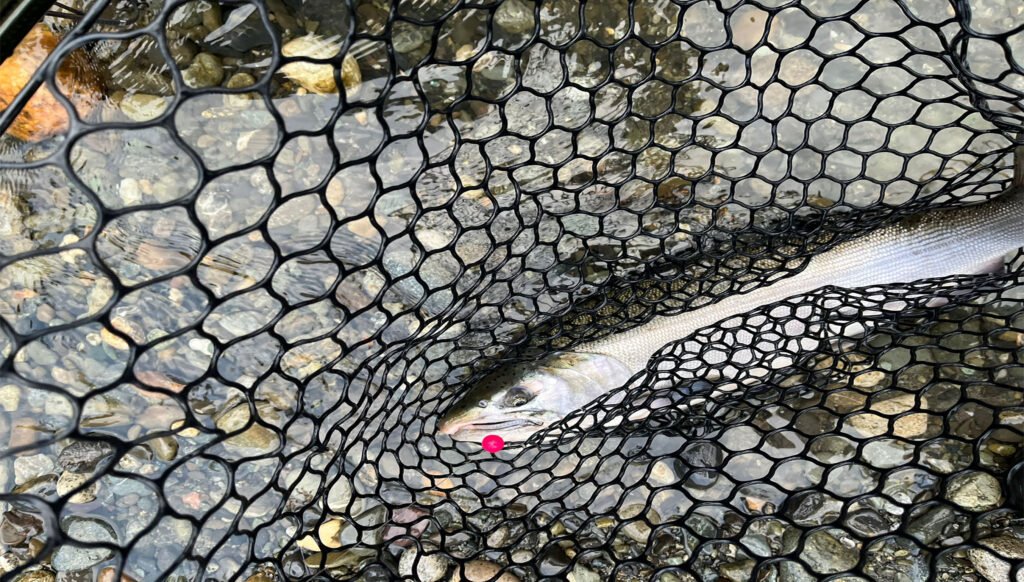
DFO Guidelines and Regional Closures
DFO regulates BC salmon fishing by species, region, and season. Closures can be called at any time — particularly during fall runs when escapement data may trigger emergency restrictions. Key regional examples for 2026:
| Region | Typical Closure Period | Key Restriction |
|---|---|---|
| Lower Fraser River | Season-dependent | Chinook catch and release only at peak periods |
| Skeena River | July–September | Barbless hooks mandatory throughout |
| Nass River | August–October | Single hook, maximum size 1/0 |
| Vedder/Chilliwack | Fall run windows | Check weekly — closures called with short notice |
These are examples only — always verify current rules at the DFO website and download the current BC Freshwater Fishing Regulations synopsis before each trip. Our BC Fishing Licence Guide 2026 covers the full licensing requirements — including the new FWID system effective April 1, 2026 — that apply to all salmon fishing in BC.
Barbless Hooks — Why They Are Required and Why They Work
Barbless hooks are mandatory across many BC salmon waters and strongly recommended everywhere else. We use them as a default on all our catch and release salmon BC setups because of the clear evidence on fish survival:
- Removal time drops significantly — faster hook removal means less handling time and less stress on the fish
- Wound size is smaller — barbless hooks cause less tissue damage on entry and exit
- Deep-hook risk decreases — barbless hooks are easier to back out before the fish swallows them
- All BeadnFloat soft beads are compatible with single barbless hook setups across all sizes from 6mm to 19mm
- Check specific water rules in the BC regulations synopsis — some waters require barbless; all benefit from it
Licence Requirements for BC Salmon Fishing
A valid BC Freshwater Fishing Licence is mandatory for all anglers 16 and over. Retaining Chinook or Coho also requires a Salmon Conservation Surcharge stamp. Starting April 1, 2026, licences link to a Fish and Wildlife ID (FWID) through the new WILD online system.
Licence checklist:
- BC Freshwater Fishing Licence — resident or non-resident depending on your status
- Salmon Conservation Surcharge — required if retaining salmon species
- FWID — replaces the old Angler Number system from April 1, 2026
- Carry government photo ID and your licence copy on the water at all times
- Full breakdown — including fees, purchase portals, and what to carry — in our BC Fishing Licence Guide 2026
- Buy online at gov.bc.ca/fishing or through the WILD system for 2026–2027 licences
💰 BEADNFLOAT CATCH AND RELEASE TACKLE — SIZE AND WATER GUIDE:
Matching bead size to water clarity and depth is one of the most overlooked factors in catch and release salmon BC fishing. Here’s how we match our BeadnFloat soft beads to conditions:
| Water Clarity | Recommended Bead Size | Fishing Depth | Top Style |
|---|---|---|---|
| Clear | 6–8mm | Shallow | 50/50 Soft Beads |
| Moderate | 8–10mm | Medium | Embryo Soft Beads |
| Murky / Stained | 10–14mm | Deep | Mottled Soft Beads |
| Fast / Tidal | 14–19mm | Deep runs | Mottled Soft Beads |
All BeadnFloat soft beads: $7.88/pack | 40+ Colours | Free Shipping $55+
SHOP THE FULL CATCH AND RELEASE RANGE →
Best Spots for Catch and Release Salmon Fishing in BC
British Columbia’s salmon waters range from massive tidal river systems to intimate interior streams. We fish across all of them and have developed specific guides for the most productive locations. Here’s the regional breakdown for catch and release salmon BC fishing:
Coastal Rivers and Estuary Systems
Coastal rivers and estuaries are the primary entry points for returning salmon and among the most productive catch and release fishing environments in the province. The Fraser River is BC’s largest salmon producer — a massive system with multiple accessible entry points for anglers, from tidal sections near the coast to interior runs deep into the Interior Plateau.
Key coastal systems for catch and release salmon BC fishing:
- Fraser River — our Fraser River fishing guide covers this system in full; all five Pacific salmon species run here at different times
- Chilliwack/Vedder River — one of BC’s most productive Coho and Chinook rivers; full tactics in our Chilliwack River salmon guide
- Nicomen Slough — bank-accessible, tidal-influenced slough with excellent fall Coho and Chum runs; see our Nicomen Slough fishing guide
- Estuaries and tidal zones — staging areas where salmon rest before upstream migration; tidal timing from the Canadian Hydrographic Service helps predict when fish are most active
In estuary and tidal environments, mottled soft beads in larger sizes (12–19mm) perform well in the stained, fast water that characterises these zones.
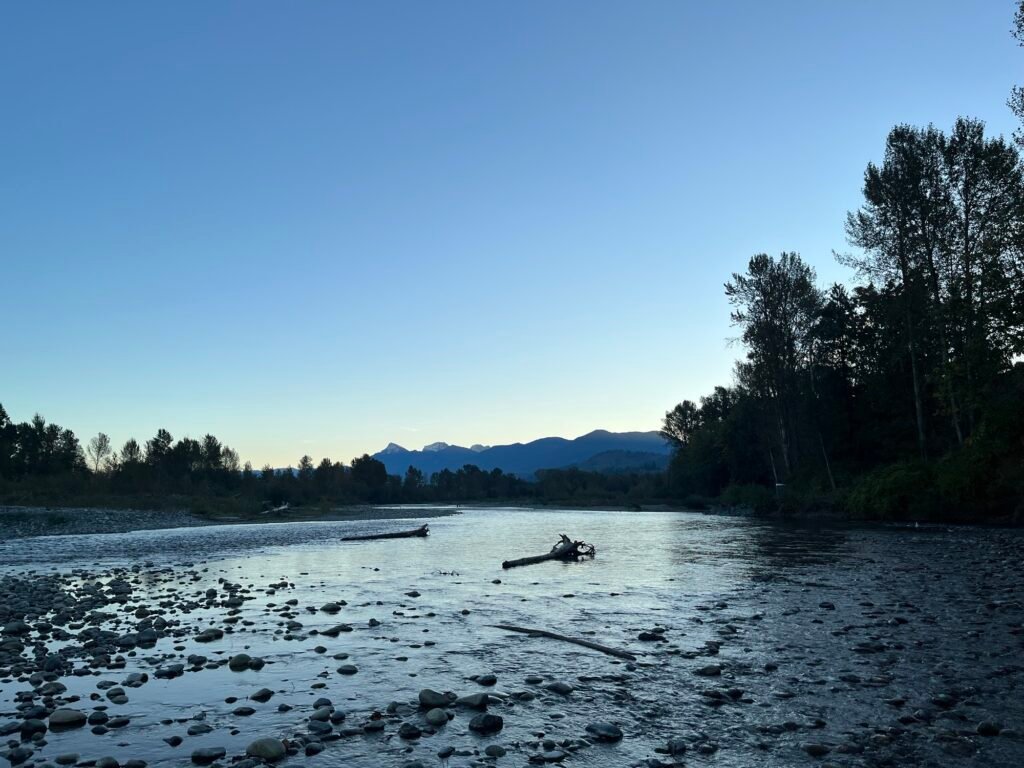
Interior Watersheds and Seasonal Migration Patterns
BC’s interior watersheds — the Thompson, Nechako, Skeena, and their tributaries — hold some of the province’s most iconic catch and release salmon BC fisheries. Knowing when each species arrives in each system is the key skill for interior fishing.
Interior watershed notes:
- Thompson River — world-famous for its late-run Chinook and Coho; check DFO’s in-season updates closely as rules vary significantly by run timing
- Skeena system — trophy Chinook and Steelhead country; our steelhead trout fishing guide covers shared technique principles
- Vedder River — one of the Lower Mainland’s most accessible interior systems; our Vedder River spring fishing guide and Vedder River fishing regulations guide are essential reading
- Smaller beads (6–8mm 50/50 soft beads) often outperform in the clear, low water of late-season interior rivers
How to Practice Catch and Release Salmon BC Fishing Responsibly
We consider responsible catch and release salmon BC fishing a set of habits — things we do automatically on every trip because we’ve made them instinctive. Here’s the full framework we follow:
Minimising Handling Time and Stress
Every second a salmon spends out of the water is a second of physiological stress. The goal is to keep that number as close to zero as possible on every release.
Handling time guidelines:
- Prepare your release before the fish is fully landed — net in hand, hook removal tool ready
- Keep the fish in or immediately beside the water throughout the process
- Use wet hands or a wet cloth — never dry hands or gloves on the body of the fish
- Avoid touching the gills or eyes at all times
- If a photograph is necessary, keep the fish horizontal and close to the water surface
- Total air time for photographs: no more than a few seconds per exposure
- Our BeadnFloat soft beads rigged 2 inches above the hook tend to set in the corner of the jaw — making removal faster and reducing handling time significantly
Using Landing Nets That Protect the Slime Coat
The slime coat on a salmon is its primary defence against infection and disease. Damage it during landing and the fish’s survival odds drop even after a technically clean release.
Net selection:
- Use knotless rubber-mesh nets only — traditional knotted mesh removes slime coat on contact
- Rubber mesh also reduces fin and hook tangling, speeding up the release process
- Size the net to the fish — a net too small forces the salmon into an unnatural bend that causes additional stress and potential injury
- Keep the net submerged while the fish is in it where possible
- Organisations like the Fraser Basin Council and Habitat Conservation Trust Foundation support best-handling education across BC river systems
“Keep ’em wet. It is not a slogan — it is the single most effective thing we can do to improve post-release survival rates for BC salmon.”
Proper Reviving Techniques Before Release
A fish that appears still in the water is not always ready to be released. We take revival seriously because it is the final step that determines whether the fish survives the encounter.
Revival steps:
- Hold the salmon upright in the water, facing into the current — this allows oxygenated water to flow naturally over the gills
- Never move the fish back and forth — this “pumping” motion is ineffective and has been shown to impair respiration
- Support the fish gently under the belly and near the tail — do not squeeze
- In cold water, recovery can take several minutes — be patient
- Wait until the fish kicks away under its own power before releasing your hold
- If the fish rolls or cannot maintain its position after release, retrieve it and resume revival
Advanced Catch and Release Techniques for BC Salmon Fishing
Beyond the basics, a few advanced techniques separate good catch and release salmon BC anglers from great ones. These approaches focus on reducing cumulative injury across the full angling encounter — from strike to release.
Managing Hook Placement and Removal
Hook placement is partly a function of your rig design. The standard BeadnFloat approach — rigging a soft bead approximately two inches above the hook — results in a high proportion of maxillary and corner-of-jaw hook-ups. These are the fastest to remove and cause the least tissue damage.
Hook management principles:
- Rig your Embryo bead or mottled bead 2 inches above the hook for optimal jaw placement
- If a fish is hooked deeply, cut the line close to the hook rather than attempting removal — it causes less damage and the hook will dissolve faster than further manipulation
- Carry needle-nose pliers or a dedicated hook removal tool on every trip
- Never use jig or hook setups with barbs on classified waters — barbless is required and results in faster, cleaner removals everywhere
- Review our Coho soft bead guide, Chum salmon bead guide, and Sockeye soft bead guide for species-specific rigging that optimises hook placement
Choosing the Right BeadnFloat Soft Beads for Your Setup
Selecting the right bead for conditions is part technique, part conservation — the right presentation means fewer missed strikes, fewer long fights, and cleaner hook sets that are easier to remove.
Bead style guide for catch and release salmon BC fishing:
- 50/50 soft beads — half-clear, half-opaque; best for clear, low-water conditions where a subtle presentation is required for Coho and cutthroat
- Embryo soft beads — premium natural egg imitation; our most versatile option across all BC salmon species and seasons
- Mottled soft beads — high-visibility patterns for stained water, tidal zones, and late-season Chum; bold colours in chartreuse, pink, and orange
- For pink salmon: smaller sizes (8–10mm) in natural tones or hot pink depending on run density
- For steelhead: larger sizes in natural tones; see our steelhead bead guide for full colour and size guidance
Rigging technique:
- Standard bead-up rig: thread bead onto mainline, peg 2 inches above the hook with a toothpick or bead peg
- Single bead on a simple hook rig allows maximum natural movement in the current
- For jig setups: bead paired above a light jig head gives a depth-adjustable presentation effective across all zones
- Check the full selection of compatible tackle in the BeadnFloat shop
BC Salmon Conservation Efforts and Angler Responsibility
Responsible catch and release salmon BC fishing doesn’t end at the riverbank — it extends into how we support the broader conservation systems that protect salmon habitat and population data year-round.
Supporting Habitat Restoration
Salmon survival depends not just on how we handle the fish we catch, but on the quality of the rivers they return to. Habitat degradation — from agricultural runoff, riparian clearing, and water temperature increase — is one of the leading threats to BC salmon stocks.
Ways BC anglers can contribute:
- Support the Pacific Salmon Foundation — BC’s leading salmon conservation organisation, funding habitat restoration across the province
- Volunteer with or donate to the Habitat Conservation Trust Foundation BC, which funds riparian and watershed restoration projects
- Support the Fraser Basin Council for watershed health initiatives across the broader Fraser system
- Back wetland conservation through Ducks Unlimited Canada, whose wetland preservation work benefits salmon-spawning habitat
- Report riparian damage, pollution incidents, or unusual fish kills to DFO’s reporting line
Reporting Tagged Fish and Catch Data
Every tagged fish an angler reports gives fisheries scientists data they cannot gather any other way. This information directly shapes the regulations that determine how many salmon we can keep, which waters stay open, and which populations need emergency protection.
| Type of Data | Conservation Value |
|---|---|
| Tagged fish reports | Migration patterns, population size estimates |
| Catch data (species, location, size) | Informing harvest limits and closures |
| Habitat condition reports | Identifying areas needing active restoration |
| Anomalous fish observations | Early detection of disease and population stress |
Report tagged fish and catch data directly to DFO or through the Pacific Salmon Foundation’s citizen science programs. The Sport Fishing BC directory also connects anglers with local clubs and monitoring initiatives that rely on angler-reported data.
FISH LEGALLY AND RESPONSIBLY WITH COMPLETE CONFIDENCE
You now have the full framework for responsible catch and release salmon BC fishing:
- Why catch and release matters — and what it actually protects
- Current 2026 DFO regulations, licence requirements, and how to check closures
- Handling, revival, and net selection techniques that maximise post-release survival
- Advanced hook placement and bead rigging for cleaner, faster releases
- The best rivers and systems for catch and release salmon fishing across BC
- How to contribute beyond the river — data reporting, habitat support, and conservation organisations
Ready to gear up for responsible BC salmon fishing?
🎣 BeadnFloat — Catch and Release Designed Tackle
✅ Legal on classified waters — single barbless hook compatible: 6mm, 8mm, 10mm, 12mm, 14mm, 16mm, 19mm
✅ Proven for Coho, Chum, Sockeye, Pink, and Chinook salmon
✅ Soft construction reduces fish injury on hook set and release
✅ Complete range: soft beads, jigs, soft worms, Rod Huggers
✅ Free shipping $55+ | 30-day returns | $7.88/pack
SHOP COMPLIANT CATCH AND RELEASE TACKLE NOW →
Conclusion
To bring this together, here are the principles that guide every responsible catch and release salmon BC fishing trip we take:
- Check DFO’s current regulations the evening before every trip — closures can land with short notice, especially in fall
- Hold a valid licence and carry it on the water — see our BC Fishing Licence Guide 2026 for the full breakdown
- Use barbless hooks, a knotless rubber net, and keep handling time to an absolute minimum on every fish
- Revive every salmon properly before release — wait until the fish kicks away under its own power
- Match your soft bead size and style to conditions for cleaner hook sets and faster releases
- Support the conservation organisations and data programs that protect BC’s salmon for the next generation
The rivers that give us these moments — the cold current, the silver fish in the morning mist — are worth every careful choice we make on the water. We’ll see you out there.
For more BC fishing information, explore our guides to the Fraser River, Vedder River, Nicomen Slough, and our full fishing guide library.
FAQ
Q: Why is catch and release salmon BC fishing so important today?
A: Catch and release salmon BC fishing protects wild populations that are under increasing pressure from environmental change, habitat loss, and fishing effort. When we release wild salmon — particularly unclipped fish — we allow them to spawn and sustain the run that brings us back to the same river next year. According to the Pacific Salmon Foundation, maintaining viable spawning escapement is the foundation of every sustainable BC salmon fishery.
Q: What are the main salmon fishing regulations BC anglers must follow in 2026?
A: BC salmon fishing regulations are set by Fisheries and Oceans Canada (DFO) and vary by region, species, and season. Key requirements include barbless hooks on many classified waters, adherence to regional closures, and possession of a valid BC Freshwater Fishing Licence with a Salmon Conservation Surcharge when retaining salmon. We always check the current BC regulations synopsis and DFO’s in-season updates before every trip.
Q: How do I practice catch and release salmon BC fishing to give each fish the best chance of survival?
A: The three most important things are: keep the fish in the water as much as possible, use a knotless rubber landing net to protect the slime coat, and revive the fish properly before release — holding it upright, facing into the current, until it kicks away under its own power. Rigging BeadnFloat soft beads 2 inches above the hook also significantly improves jaw hook placement, which makes removal faster and reduces handling time across the board.
Q: What are the best rivers for catch and release salmon fishing in BC?
A: BC has world-class options across every region. The Skeena system is renowned for large Chinook. The Vedder-Chilliwack is one of the Lower Mainland’s most accessible Coho and Chinook rivers — see our Chilliwack River salmon guide and Vedder River spring fishing guide. Nicomen Slough is an excellent option for bank-access Coho and Chum — see our Nicomen Slough fishing guide. The Fraser River is BC’s largest salmon producer and holds all five Pacific salmon species.
Q: Which BeadnFloat soft bead size and colour works best for catch and release salmon BC fishing?
A: Match bead size to water clarity and depth. For clear shallow water, 6–8mm in our 50/50 range or natural-tone Embryo beads are top producers. In stained or deeper water, step up to 10–14mm mottled beads in chartreuse or hot pink. Full species-specific guidance is in our Coho guide, Chum guide, Pink salmon guide, and Sockeye guide.
Q: How do I revive a salmon properly before catch and release?
A: Hold the salmon upright in the water, facing into the current — this allows oxygenated water to flow naturally over the gills. Do not move the fish back and forth; this impairs rather than assists respiration. Support the fish gently under the belly, keep it in position until it feels strong, and wait until it kicks away under its own power before releasing your hold. In cold water, full revival can take several minutes. Patience here directly determines whether the fish survives.
Q: Why are BeadnFloat soft beads a better choice for catch and release salmon fishing?
A: Our soft beads mimic the translucency and movement of natural salmon roe, encouraging a clean take rather than a reactive strike. Their soft construction reduces injury compared to hard roe imitations on hook set, and the standard 2-inch-above-hook rigging results in a high proportion of maxillary hook placements — the fastest and cleanest to remove during release. They are also fully compliant with single barbless hook requirements across BC classified waters where artificial lures are permitted.
Q: How do BC salmon conservation efforts benefit from individual angler actions?
A: Individual anglers contribute to conservation in three direct ways: practising proper catch and release techniques that improve fish survival, reporting tagged fish and catch data to DFO and the Pacific Salmon Foundation to inform population management, and supporting habitat restoration organisations like the Habitat Conservation Trust Foundation and Fraser Basin Council. Every fish released cleanly, and every data point reported, compounds into better management decisions that protect the fishery for future generations.
Q: Do I need a special licence for catch and release salmon fishing in BC?
A: Yes. A valid BC Freshwater Fishing Licence is required for all anglers 16 and over, regardless of whether you intend to retain fish. If you plan to retain any Chinook or Coho, you also need a Salmon Conservation Surcharge stamp. Starting April 1, 2026, all licences link to a new Fish and Wildlife ID (FWID) system. Our BC Fishing Licence Guide 2026 covers everything — what to buy, where to buy it, what to carry on the water, and how the new FWID system works.
Q: What gear should I have for a responsible catch and release salmon BC fishing setup?
A: A responsible catch and release salmon BC setup includes: barbless hooks (required on many BC waters), a knotless rubber-mesh landing net, a hook removal tool or needle-nose pliers, and soft beads matched to the species and water conditions. For managing multiple rods on the bank, BeadnFloat Rod Huggers keep spare setups secure and ready. Find everything you need in the BeadnFloat shop.

About author

Add comment